

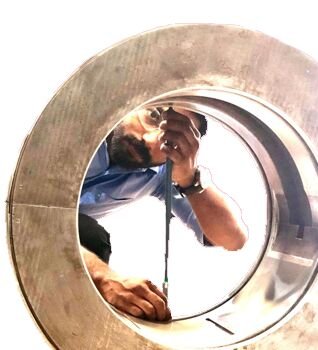
For decades, operators of turbines, compressors and pumps across Saudi Arabia faced the same constraint: when a hydrodynamic bearing or a carbide cutting tool failed, the replacement had to be imported. Lead times stretched into months, foreign-exchange costs mounted, and a single out-of-spec component could keep critical rotating equipment offline far longer than the repair itself warranted.
That constraint is exactly what local, licensed manufacturing is built to remove.
Why proximity changes the economics
A bearing is not a commodity. White-metal lined components must be cast, bonded, machined to micron tolerances, and ultrasonically certified before they can be trusted back in service. When that work happens overseas, every iteration — every inspection query, every drawing clarification — adds a shipping cycle. When it happens in Jubail, the same conversation happens over a site visit.
This is why SACOM provides an 8,000 working-hour or two-year warranty on all manufactured and repaired bearings, and why our cutting-tool lead times run at roughly one-sixth of international manufacturers. Proximity compresses the feedback loop between engineer and machinist.
The three pillars of a reliable bearing system
Manufacturing a bearing that lasts depends on three capabilities working together:
- Metallurgical casting technology — including centrifugal casting, the recognised best technique for lining bearings with white metal;
- Knowledge of tribology and metal systems — understanding how surfaces, lubricants and loads interact over time;
- Control of the hydrodynamic oil film — the thin wedge of oil that keeps metal from touching metal at speed.
Get one wrong and the component may pass inspection yet fail in the field. Get all three right and you extend the life of the entire machine.
Local manufacturing and Vision 2030
Saudi Vision 2030 calls for a more diversified, self-reliant industrial base. Precision component manufacturing is a quietly strategic part of that picture: it keeps maintenance know-how, tooling and spare-part capacity inside the Kingdom rather than dependent on distant supply chains. Every bearing reclaimed in Jubail, every carbide tool reground locally, is a small contribution to industrial resilience.
For the engineers who keep Saudi industry turning, that resilience is not abstract — it is the difference between a planned overhaul and an unplanned shutdown.
Have a rotating-equipment component or cutting tool you’d like manufactured, repaired or reverse-engineered? Talk to our team in Jubail.